Looking forward to seeing Black Country, New Road sometime soon so here’s a song by them called basketball shoes!
Measles infections and immunological amnesia
In last week’s blog, we explored the current rise of measles outbreaks and the public health challenges they present. Today, we will introduce why this virus is so dangerous by reviewing the article “Measles and Immune Amnesia” by Hagen. Hagen explains that the measles virus (MV) is particularly insidious because of how it enters and moves through the body. The virus enters through the respiratory tract, where the virus first targets alveolar macrophages, which are immune cells in lungs meant to destroy invaders. MV hijacks these cells by binding to a specificreceptor called the Signaling Lymphocytic Activation Molecule (SLAM). Instead of being destroyed, the virus uses these macrophages as “Trojan horses” to travel directly to the lymph nodes, and further spreads to memory T-cells and memory B-cells.
During the infection, the virus destroys these pre-existing memory T and B cells (they remember every disease you had!). While the body eventually clears the measles virus and replaces the lost white blood cells, the replaced cells are almost exclusively MV-specific lymphocytes. As an example, your immune system had a catalogue of past defenses, but they got burned down and replaced with a simple instruction on how to fight measles. This would leave their immune system in a state of amnesia. While they are now immune to measles for life, they have lost the protection they previously earned against other simple diseases like pneumonia or the flu. Their immune system is essentially reset to that of a newborn baby, making them highly vulnerable to secondary infections that their body should have known how to fight.
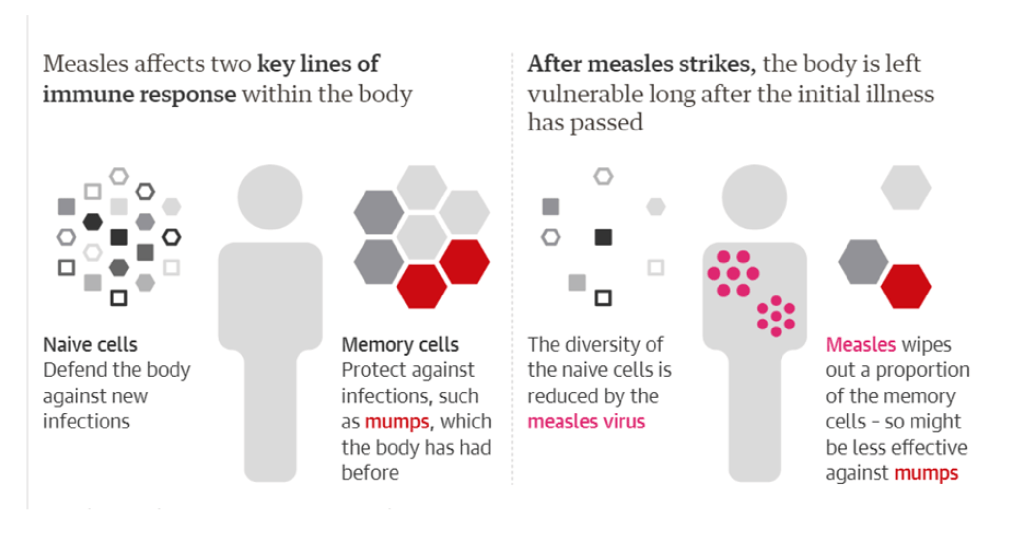
credits to Epidemiology Unit Ministry of Health of Sri Lanka
How measles make other diseases deadly
In her article, Hagen highlights a discovery that nearly half of all childhood deaths from infectious diseases in the pre-vaccine era were linked to measles, even if the child didn’t die from measles itself, as measles are a gateway and enhacer for other diseases. If a child catches measles, their immune system would be weakened and for the next two to three years that they might die from a common bacterial infection that their body would have normally survived. The effect isn’t just about being sick with a rash, but an almost permanent removal of the armor that protects children from everything else. Even if you catch a cold that is not deathly the first time after measles, your immune system would not remember it and take out all the energy possible to fight it off.
Based on our last blog about the success of the MMR vaccine, we are primarily only able to investigate this problem using historical data because it would be unethical to study this in a modern controlled setting. To observe immune amnesia today, researchers would have to allow a population of children to remain unvaccinated and to intentionally get measles to prove the presence of immunological amnesia, which gives them many life dangers. Furthermore, because modern medicine can sometimes save children from the secondary infections caused by immune amnesia, the data today wouldn’t look the same as it did in the 1940s. Therefore, we look at historical data from before and after the vaccine’s introduction (the 1960s) because it provides a clear explanation that when measles disappeared due to vaccination, deaths from other unrelated infections would plumment, proving that the vaccine was protecting children from much more than measles singularly.
MMR vaccine does not cause immunological amnesia
In Mina et al.’s research, the researchers determined if the MMR vaccine carried the same risk of resetting the immune system as the natural virus. They used a sophisticated tool called VirScan to track the antibody repertoires of children. Their investigation confirmed that while a natural measles infection wiped out between 11% and 73% of a child’s pre-existing antibodies, the MMR vaccine caused no such loss. This study is fundamental in proving that the vaccine provides lifelong protection against measles without the cost of leaving the patient vulnerable to other diseases. Even more, it prevents the vulnerability to future infections caused by measles infections, protecting children of various diseases.
The experimental data involved analyzing the blood of children before and after they received their MMR vaccination and comparing them to a group of children who got the wild-type virus during an outbreak in the Netherlands. Researchers used the VirScan platform to screen the blood for antibodies against thousands of different pathogens simultaneously, including common childhood illnesses and various bacteria. The data showed that children who were naturally infected saw a massive drop in the diversity of their antibody pools, effectively losing their immune memory of previous exposures. In contrast, the children who received the MMR vaccine showed zero significant reduction in their preexisting antibody diversity. Therefore, this study proves that the vaccine successfully triggered the production of new measles-specific antibodies without displacing or destroying the old ones.

 atom heart prophet's micro blog