
Looking forward to May very much so here is May Ninth by Khraungbin! A very cute little alternative/world song that makes you feel like you’re in a sunny cozy bedroom.
The current situation of measles
Measles is a highly contagious disease caused by a enveloped RNA virus, and is spreads easily through respiratory droplets, such as when coughing or sneezing. It can cause immunological amnesia, in which it eradicates the memory of infections, causing in some cases death. Though measles can affect anyone, they are most common in children and pregnant people, specifacally unvaccinated ones. Measles is currently common in parts of Africa, the Middle East and Asia. In these places, there are more damaged health infrastructures and interruptions in routine immunization,which increases the risk of infection. In the current 2026 outbreak, measles cases are most present in places with high population density, such as schools and even ICE detention centers.
In Spartanburg County, the outbreak center for South Carolina, over 700 of the approx. 1000 cases were of children under 17 years old, with 456 in the 5-11 age range. This proves that measels cases have been spreading through daycare centers and facilities with a large amount of young children. Across all age groups, over 90% of infections were of unvaccinated people. It is worth noting that 21 of all infected cases are only partially vaccinated, so getting the required number of doses is crucial. As of March 28th, South Carolina had not had new cases of measels for over a week, signaling process.
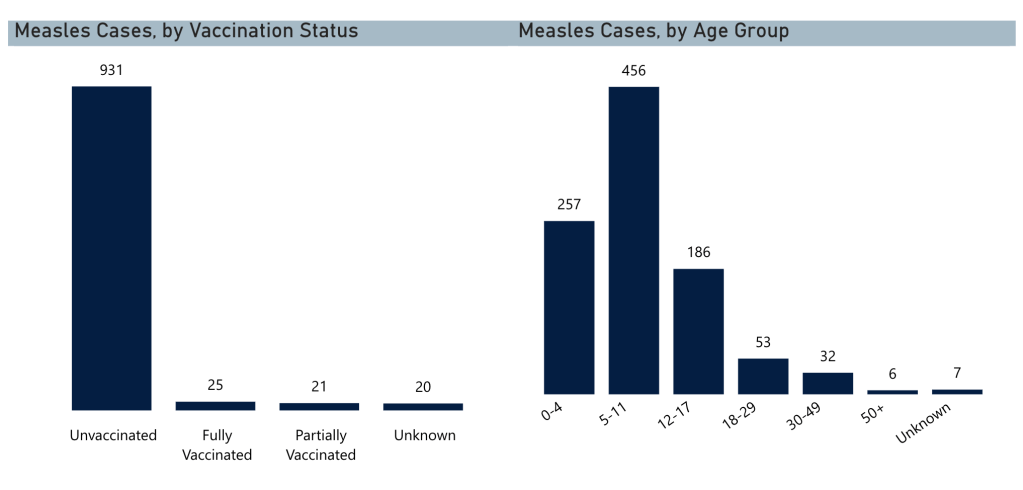
Photo from measels dashboard of South Carolina
In comparison to the 2019 outbreak
As of March 27th 2026, the United States measles outbreak cases have surged to 1,575 across 32 jurisdictions. This figure represents a higher number compared to 2025, where 2,285 cases were recorded over the entire year but only three months into 2026 we had almost 70% of what we had the last entire year, indicating that 2026 the most impacted year in history. The current trajectory is the continuation of large clusters of infections from late 2025. Geographically, the crisis is most acute in South Carolina, Utah, Texas, and Florida, occuring because there are vaccination gaps allowing the virus to spread beyond initial travel related introductions to the country. Consequently, the Pan American Health Organization stated that the U.S. remains at high risk of losing its regional measles elimination status due to its sustained transmission because of a low percentage of vaccination.
The 2019 outbreak had 1282 cases in total, which is considered record breaking at the time but still less than the 2285 we had in 2025 alone. The hospitalization rate did not change much, with 10% (119 out of 1282) of hospitalization in 2019 compared to 11% in 2025. In both periods, children remain the most affected group, but 2025 saw a higher percentage of cases in the 5–19 age range compared to 2019, suggesting significant spread within school and daycare settings. In 2019: Approximately 89% of patients were unvaccinated or had unknown status. The national kindergarten MMR vaccination rate was roughly 95%, which is within herd immunity range. In this outbreak, about 93% of cases are among the unvaccinated or those with unknown status. Kindergarten vaccination coverage has dropped to 92.5%–92.7%, which cannot achieve herd immunity and allows the virus to travel further through communities.
What is the hospitalization burden of the current measles outbreak?
The ongoing measles resurgence in the 2025–2026 period has seen a sharp increase in cases, with 2,285 confirmed cases in 2025 and an additional 1,575 reported by March 27th 2026. Hospitalization rates have fluctuated significantly in these two years. In 2025, 11% of all cases required hospital care, but this rate was much higher for children under 5 (18%) and adults over 20 (12%). Approximately 93% of 2025 cases occurred in individuals who were unvaccinated or had an unknown status. While specific numbers for secondary complications are currently being tracked, historical data indicate that approximately one in five unvaccinated children with measles will require hospitalization. Populations at the highest risk for severe disease include infants and pregnant persons.
The economic impact of the 2025 measles outbreak is estimated at approximately $244 million, with the average cost per individual case reaching $104,629. These figures include direct medical expenses, which account for about 3% of the total, while public health outbreak response activities like contact tracing and testing represent roughly 65% of the financial burden. Productivity losses from missed work and school contribute another 32% to the overall cost. Further, even a 1% annual decline in MMR vaccine coverage could push annual costs to $1.5 billion by 2030. Current estimates for 2025 suggest the healthcare system bears over $166 million in costs, driven by high fixed response fees and an incremental cost of roughly $16,197 per additional case. Consequently, the current scale of the outbreak would bring a huge burden to economy that could be effectively prevented by vaccination.

 atom heart prophet's micro blog