
Hear from one of my favorite artists, Nala Sinephro, while you read!
Of course, we eat tons of sugar each day, whether pretty visibily through candy and chocolate, or obscurely by eating even pasta. Today in this blog, we will explore together how sugar affects our health by impacting the human microbiome and the gut-brain axis.
The gut-brain axis, quite literally, is made of the brain and the gut. They are like friends texting 24/7, as smooth as a two way highway that links your thoughts in your head with your friend’s, except that in your body it links your brain and gut. The friends get messages through phone wires, and in our body the massive phone line called the Vagus nerve, alongside chemical messengers like serotonin, that actually helps control your mood (your friend’s messages impacts your mood). Living inside your digestive system are microbes, like a huge extensive friend group that help digest your food and send reports to your brain. This is why eating a bunch of junk food can make you feel grumpy and tired (your friend is spamming you with useless memes and you’re bored). Essentially, your head and your stomach are a best friend team: when one is happy, the other usually feels great too.
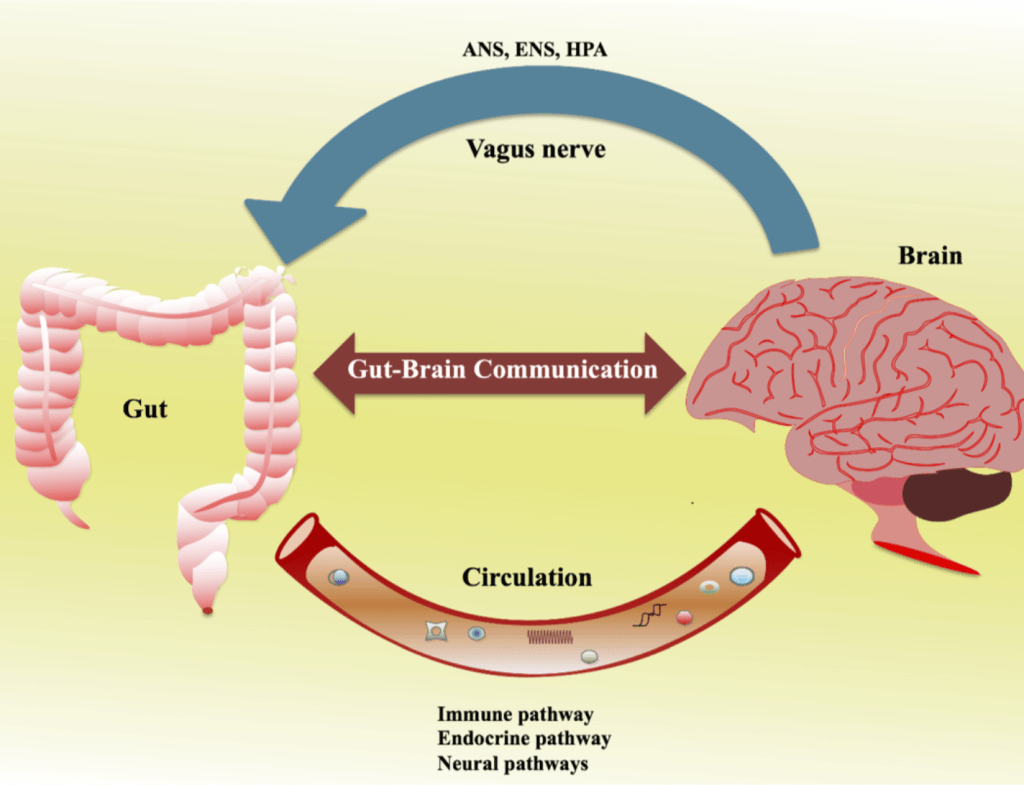
photo uploaded by Suganya, Kanmani, and Byung-Soo Koo via Widimedia
Different types of bacteria work together to keep your gut healthy. When you eat too much added sugar, you’re dumping junk food all over a city, and the bad bacteria and take over, killing the good bacteria such as Bacteroidetes, the ones that make short-chain fatty acids. Without those short-chain fatty acids, the protective gut barrier will break down, allowing harmful toxins that were supposed to stay inside to escape into your bloodstream, causing disease. Not only do they decrease the amount of good bacteria, they feed bacteria that consume the protective mucus layer of the gut, giving more space for harmful microorganims to enter. Switching to artificial sweeteners at most times would be a good option, but there are some that have negative impacts to your total health such as acesulfame K affecting glucose transport systems.
A high sugar diet can cause multiple disorders. As we mentioned above, our gut barrier would break down, leading to a leaky gut. The vagus nerve in the axis would transmit these inflammatory and neuroactive signals from the gut to the brain, such as neuroinflammation and oxidative stress. These mechanisms show that the gut-brain axis would be susceptible through neuroimmune, endocrine, and neural pathways, heightening susceptibility to neurodegenerative diseases like AD and PD, as well as neurodevelopmental disorders. Further, individuals consuming ≥25% of daily calories from added sugars had a nearly 3-fold increased risk of cardiovascular mortality, such as stroke.
The gut-brain axis facilitates a complex dialogue between intestinal microbes and the central nervous system. These associations are driven by several key microbiome-mediated mechanisms. First, the production of metabolites which can either protect or inflame the brain by modulating the activity of the brain’s immune cells. Second, direct signaling through the vagus nerve, which acts as a path for microbial neurotransmitters or toxic organisms to reach the brain. Third, molecular mimicry, where the immune system confuses bacterial proteins with brain tissue.
Today, I had a Raising Cane’s box for lunch. While these types of food seem to have low sugar content, I ate 232% of the daily recommended sugar amount for women. One savory meals often hide a full day’s worth of sugar in the condiments themselves (not counting beverages). Typically, a coleslaw would have around 20 grams of sugar, almost all of the daily recommended amount. Now, many restaurants have a protein option to swap their burger buns with a lettuce wrap, which could be a great way to eat vegetables healthier, and cut sugar in the bun.
In so called low sugar drinks, the sugar levels are higher than we expect. In a 25% sugar boba, there is 10 grams of sugar just in the tea itself. Besides that, we’re getting the boba and other syrups and sauces, which would be easily more than 20 grams of sugar. Added together, this would easily take up the quota for a whole day’s sugar income, regardless of gender. Because boba is liquid sugar combined with carbs, it hits your bloodstream almost instantly. This can cause a sugar crash that affects your mood and feeds the sugar utilizing microbes in your gut that we talked about earlier. So next time when drinking boba, we can choose healthier toppings such as chia seeds, and try to go with 0% to 25% sugar.

 atom heart prophet's micro blog
